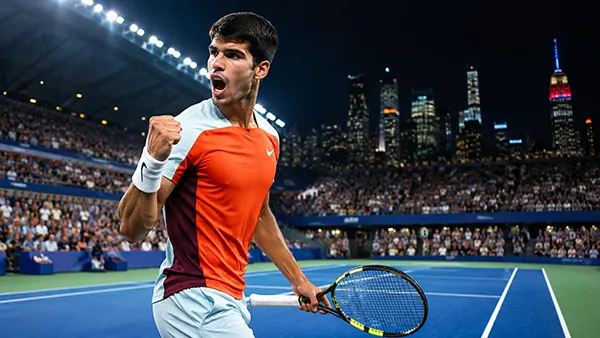
US Open 2026: Carlos Alcaraz Returns After a Four-Month Break to Defend His New York Title
Carlos Alcaraz arrived at the 2026 US Open facing a challenge unlike any other in his young career. The Spaniard had not played a singles match for 139 days after a right-wrist injury interrupted a season that had begun with another major breakthrough. Instead of building towards New York through the usual North American hard-court events, he went directly from rehabilitation and practice to a Grand Slam title defence. His return therefore carries two stories at once: the attempt to retain the championship he won in 2025 and the much more immediate question of how quickly a player can regain competitive rhythm after more than four months away. The opening rounds at Flushing Meadows have already provided useful evidence. Alcaraz has won his first two matches, his wrist has held up under match conditions, and the familiar attacking tennis has gradually returned, although he has been careful not to treat a successful start as proof that the comeback is complete.
A Four-Month Absence That Changed Alcaraz’s 2026 Season
Alcaraz’s last singles appearance before the US Open came in Barcelona in April. He had beaten Otto Virtanen in his opening match but subsequently withdrew because of a problem in his right wrist. The injury was eventually described as inflammation affecting a tendon in the wrist, and the recovery proved considerably longer than an ordinary short-term interruption. He remained out through the European clay season and the grass-court period, missing both Roland Garros and Wimbledon. For a player accustomed to competing for the largest titles throughout the year, losing two consecutive Grand Slam tournaments represented a major change of routine. It was also the longest period away from competition of his professional career, making the physical recovery only one part of the challenge.
The timing was particularly frustrating because the first months of 2026 had been highly successful. Alcaraz began the year by winning the Australian Open, completing the career Grand Slam at only 22 years of age and becoming the youngest man to win singles titles at all four majors. He also collected the Doha title and compiled a 22-3 record before the injury stopped his season. Those results had reinforced his place among the leading players in men’s tennis and suggested another year in which he would contend for several of the sport’s biggest trophies. Instead, the focus shifted abruptly from winning tournaments to allowing the wrist enough time to recover without creating a longer-term problem.
That interruption matters because tennis fitness is not simply a question of being able to run, serve and strike the ball without pain. Competitive timing, decision-making under pressure and confidence in vulnerable parts of the body are restored through actual matches. Alcaraz could train during his rehabilitation and gradually increase the intensity of his work, but practice could not fully reproduce the demands of a best-of-five-set Grand Slam encounter. He acknowledged that uncertainty himself when preparing for New York. His concern was not only whether the wrist was physically ready, but also whether he could play freely without thinking about it during important points. That distinction has shaped the way he has approached the first week of the tournament.
Why New York Became the Stage for His Comeback
Returning at the US Open carries unusual significance for Alcaraz because New York is closely connected with several of the defining moments of his career. He won his first Grand Slam title at Flushing Meadows in 2022, defeating Casper Ruud in the final and becoming world No. 1 for the first time at the age of 19. The run established him as much more than a promising young player. His speed, willingness to attack and ability to produce his best tennis in long matches made him one of the central figures in the sport almost immediately. Coming back from his longest injury absence at the same tournament therefore gives the 2026 event a connection with the place where his rise to the top level first became undeniable.
His relationship with the tournament became even stronger in 2025. Alcaraz faced Jannik Sinner in the men’s singles final and won 6-2, 3-6, 6-1, 6-4, claiming his second US Open title and his sixth Grand Slam championship at the time. The victory also returned him to the world No. 1 ranking. Twelve months later, the circumstances are almost the opposite. In 2025 he entered the final stages of the season with months of competition behind him; in 2026 he arrived with no singles match since April. The trophy he is defending is the same, but the preparation could hardly be more different.
Alcaraz did at least have an opportunity to experience Arthur Ashe Stadium before beginning the singles draw. He took part in the revamped mixed doubles event with Serena Williams and won a round, giving him some competitive court time in New York before his first singles match. Even so, that was not a substitute for the normal summer programme. Every US Open men’s champion since the tournament switched to hard courts in 1978 has played at least one North American hard-court event between Wimbledon and New York. Alcaraz entered the 2026 championship without doing so. If he successfully defends his title, he would break a pattern that has lasted through almost five decades of US Open history.
How Alcaraz Has Handled His First Matches at the 2026 US Open
The first test came against Roman Safiullin, a powerful opponent who had beaten Alcaraz at the Paris Masters in 2023. There was obvious interest in the condition of the Spaniard’s wrist, but there was also a simpler question: how would he respond to the normal nerves of competition after 139 days without a singles match? Alcaraz later admitted that the long absence had made the routines of match day feel unfamiliar. Once play began, however, he produced an efficient performance. He defeated Safiullin 6-4, 6-4, 6-4, taking the necessary chances in each set without being forced into a prolonged contest. Just as importantly, he reported afterwards that his body felt good.
The second round against Jaime Faria revealed more about the state of his comeback because the match did not begin according to plan. Faria took the opening set 6-4, giving Alcaraz his first significant competitive problem since April. The defending champion’s response was immediate. He won the second set 6-0, followed it with a 6-3 third set and closed the match 6-2 in the fourth. Rather than reacting badly to the early setback, Alcaraz became more assertive as the contest progressed and won 18 of the final 23 games. That ability to change the direction of a difficult match is particularly important for a player returning without the confidence normally built through several preparation tournaments.
The performance was not flawless, and that is part of what makes it useful for judging his current level. Alcaraz needed time to settle, particularly with his serve, and the first set showed that competitive sharpness cannot simply be restored in training. Yet he improved while the match was being played instead of fading as the physical workload increased. By the closing stages he was serving more freely and attacking with greater conviction. After two rounds he had accumulated roughly five hours of singles match time in New York. That is still a small sample after such a long absence, but the progression from a controlled straight-sets win to a four-set recovery has given him two different types of test without exposing the wrist to an extreme marathon.
What the Early Matches Say About His Wrist, Rhythm and Game
The most encouraging feature of Alcaraz’s first week is that he has been able to play his normal style rather than visibly protecting the injured wrist. A player returning from this type of problem can be medically cleared yet still hesitate on particular strokes or during moments that require maximum acceleration. Against Safiullin and Faria, Alcaraz increasingly committed to his shots as the rallies developed. His forehand remained an important attacking weapon, and his serve became stronger during the second-round match. The significance lies less in individual speeds or statistics than in the fact that he was willing to hit decisively when points became important.
Match rhythm is a different matter. Four and a half months without singles competition cannot be removed in two evenings, and Alcaraz has spoken openly about the strange feeling of returning to the routines and pressure of tournament tennis. He has also said that he missed those difficult moments while he was away. That attitude helps explain why the dropped opening set against Faria may have been useful rather than purely negative. He had to solve a problem in real time, deal with frustration and trust his game while trailing. Those experiences are impossible to recreate completely on a practice court and become increasingly important as opponents improve in the later rounds.
Alcaraz has therefore kept his public expectations measured despite entering as the defending champion. His immediate priority has been to remain healthy throughout the event and to finish the tournament with confidence in the wrist. That does not mean he has abandoned the goal of winning. Once he steps onto the court, his competitive instincts remain unchanged. The difference is that success in New York can be judged on more than the final result. Each pain-free match gives him information about how his body responds, while every difficult set helps restore the reactions that were automatic before the injury. For a player accustomed to being judged almost entirely by trophies, this US Open requires a broader view of progress.
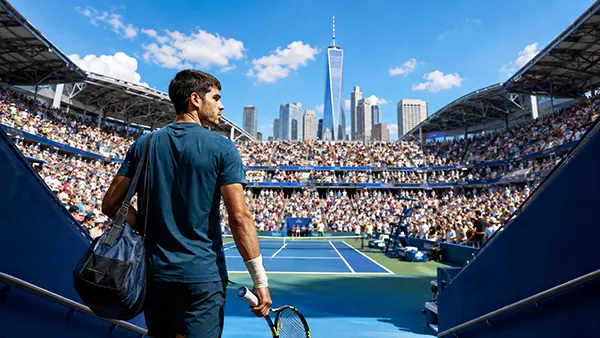
The US Open Title Defence Is Bigger Than a Normal Comeback
Alcaraz is trying to achieve something no man has managed at the US Open since Roger Federer completed the last of five consecutive titles in 2008. Since then, champions including Rafael Nadal, Novak Djokovic, Andy Murray, Marin Cilic, Stan Wawrinka, Dominic Thiem, Daniil Medvedev and Jannik Sinner have all been unable to successfully defend the men’s singles trophy in the following year. That record shows how difficult New York can be even for players who arrive healthy and fully prepared. Alcaraz is attempting the same task after the longest competitive absence of his career, which makes the circumstances of his defence markedly different from a standard attempt to repeat a Grand Slam victory.
His next test is scheduled for 4 September against China’s Yibing Wu in the third round. Wu reached this stage by defeating Adam Walton in straight sets and then James Duckworth, also without dropping a set. For Alcaraz, the match represents another opportunity to build competitive volume while the stakes steadily increase. The first two rounds have shown that he can manage both a relatively controlled match and an early setback, but the deeper stages of a Grand Slam demand repeated recovery between best-of-five-set contests. That aspect remains largely untested because he did not have a normal tournament schedule before arriving in New York.
The wider draw also means that there is little value in treating the early victories as evidence that a successful title defence is inevitable. Grand Slam tournaments tend to become progressively more demanding, and Alcaraz is still learning how his body reacts after multiple rounds. His natural athleticism and variety give him ways to shorten points or change patterns when necessary, but the central issue remains durability. There is a significant difference between feeling healthy after one match and completing seven matches across two weeks. The early evidence is positive; the larger test is still developing as the tournament moves towards its second week.
What This Comeback Could Mean Beyond New York
The 2026 season has also forced Alcaraz to reconsider how he manages his calendar. After returning in New York, he indicated that longer voluntary breaks may become part of his future planning because he felt physical and mental benefits from spending time away from constant competition. His injury absence was not a chosen holiday, and rehabilitation came with its own frustrations, but it gave him an unusual period without the weekly cycle of travel, practice and matches. At 23, with seven Grand Slam titles already won, he is in a position where protecting the length of his career may become as important as adding another event to an already crowded schedule.
That subject has relevance beyond one player. The leading men can spend much of the year moving between continents, surfaces and tournament categories, with very limited periods for uninterrupted recovery and training. Alcaraz’s wrist injury is an individual medical issue and should not be presented as proof of a single cause, but his comments reflect a broader debate about how elite tennis schedules affect players over time. His intention to consider planned breaks suggests that the experience of 2026 may influence future decisions even after the wrist problem is fully behind him. For supporters, that could mean seeing him compete less frequently at certain points of the year but with more deliberate recovery periods between demanding stretches.
For now, New York remains the immediate measure. Alcaraz has already achieved the essential first step by returning to singles competition and completing two matches without a reported recurrence of the wrist problem. He has also shown that the competitive qualities that carried him to two previous US Open titles have not disappeared during the lay-off. What has not yet been established is how those qualities will hold up over the full length of a Grand Slam. The third round against Wu is the next part of that answer. A successful title defence would place Alcaraz in rare US Open company, but even before the champion is decided, his 2026 return has become a significant test of recovery, patience and the ability to regain world-class match form under the brightest lights in New York.