F1: How the Sprint-Weekend Starting Grids Are Set — and Where Fans Most Often Get Confused
Sprint weekends look simple on TV: a short race on Saturday, the Grand Prix on Sunday, and “qualifying somewhere in there”. In reality, the weekend contains two separate grid-setting stories running in parallel, plus a few rule quirks that can make the on-screen graphics misleading. If you’ve ever wondered why a driver can finish well in the Sprint yet still start the Grand Prix further back, or why a penalty “doesn’t show up” until later, the answer is usually that you’re mixing the two grids.
The sprint-weekend timeline: which session sets which grid
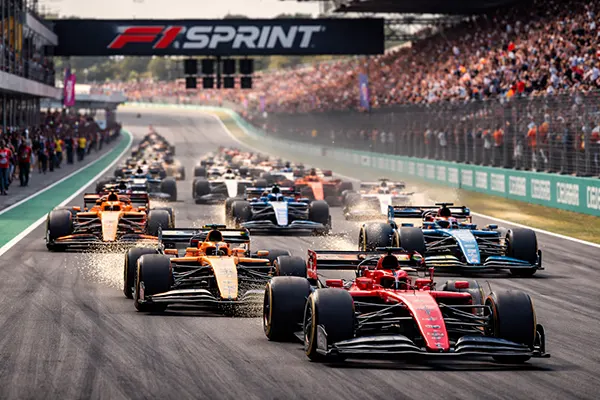
On a modern Sprint weekend (the format retained for the six Sprint events on the 2026 calendar), Friday typically includes one Free Practice session and then Sprint Qualifying. Sprint Qualifying is not the same as the regular Saturday qualifying session, and it is not a “warm-up” either: it is a dedicated session that exists for one job only — setting the starting grid for the Sprint race.
Saturday then has two headline sessions. First comes the Sprint itself, run over a short distance with its own sporting consequences (points for the top finishers), but it does not create the starting order for Sunday. Later on Saturday, traditional Grand Prix Qualifying takes place (Q1, Q2, Q3), and that is what sets the grid for the Grand Prix on Sunday.
Sunday is straightforward: the Grand Prix starting grid is built from Saturday’s Grand Prix Qualifying results, then modified by whatever race-related grid penalties apply. A useful way to remember the weekend is: Friday decides Saturday morning’s start order (the Sprint), while Saturday afternoon decides Sunday’s start order (the Grand Prix).
Why two grids exist — and why results don’t “carry over”
Fans often assume the Sprint is a mini race that “locks in” Sunday’s grid, because that is how older Sprint formats worked in earlier experiments, and because some broadcast packages still frame the Sprint as a storyline that “sets the stage”. But under the current approach, the Sprint is a standalone competitive session and does not replace Grand Prix Qualifying. A driver can therefore win the Sprint and still line up behind a rival on Sunday if they were slower in Saturday qualifying, or if a Sunday grid penalty pushes them back.
Another common mix-up comes from the order of events. Because the Sprint happens before Grand Prix Qualifying, any incidents in the Sprint (damage, a required component change, or a rules breach) can have knock-on effects that appear in the Grand Prix start order. That makes it feel like the Sprint “changed the grid”, when what really happened is that something after the Sprint affected eligibility, parts usage, or penalties for Sunday.
Finally, there is the psychological trap of seeing a driver “finish P3” on Saturday and then “start P11” on Sunday. People interpret that as unfairness or inconsistency, but it is usually just two different classifications: Sprint finishing position is one table; Grand Prix starting position is another. The sport is not applying one weekend-long ladder — it is running two separate competitive sequences.
How Sprint Qualifying builds the Sprint grid: SQ1, SQ2, SQ3 and tyre rules
Sprint Qualifying uses the familiar three-part elimination idea, but the sessions are shorter and the tyre rules are more prescriptive. In simple terms: after each segment the slowest group is knocked out, leaving a final group to fight for the front rows. The exact timings can change by regulation, but the key concept stays the same: Sprint Qualifying results directly determine the Sprint starting order, position by position.
Where fans get caught is the tyre requirement. In the recent Sprint format, teams must use a specific compound for SQ1 and SQ2 (commonly the medium), then switch to softs for SQ3. That means a lap time in SQ1 is not directly comparable to a lap time in a normal Q1, and it also means teams can’t always “fix” a poor segment with a different tyre choice — the rules narrow their options.
Another detail that creates confusion is what happens when a driver cannot set a representative time. If a lap is deleted for track limits, if a yellow flag compromises a final run, or if a red flag ends the session early, the grid is still formed from the best valid times that exist. You will sometimes see a fast car start lower than expected simply because it never completed a clean lap when it mattered, not because the team “saved tyres” or because officials rearranged anything.
The penalty split: which infringements affect the Sprint and which affect Sunday
Penalty timing is a major source of misunderstanding. A good mental model is: penalties are usually attached to the session they relate to. If a driver commits an offence in Sprint Qualifying, the grid drop typically applies to the Sprint grid. If an offence happens in the Sprint itself, it can translate into a penalty that affects the Grand Prix grid or the race outcome, depending on the type of infringement and when it is processed.
This is why you may hear commentators say things like “that penalty will be taken on Sunday”. They are not contradicting the fact that Sprint Qualifying set the Sprint grid; they are describing how the regulations route different sanctions. Crucially, a driver can be penalised without the audience seeing an immediate re-ordering of the Sprint grid on Friday night — sometimes the sanction is confirmed later, or it targets the Grand Prix rather than the Sprint.
It also explains why “he served it in the Sprint” is not always true. Time penalties in the Sprint affect Sprint classification; grid drops affect where you start; and certain technical penalties can force a pit-lane start. Without separating those buckets, it is easy to assume the stewards are being inconsistent when they are actually applying different tools to different offences.
Parc fermé and car changes: what teams can alter between Friday and Sunday
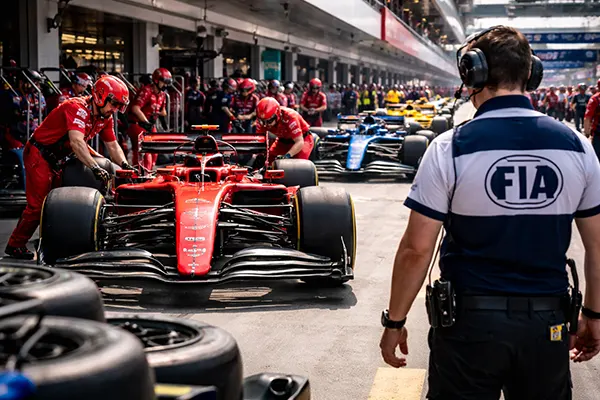
Parc fermé is the quiet rule that shapes Sprint weekends more than most fans realise. Once parc fermé conditions begin, teams are heavily restricted in what they may change on the car, because the sport wants to stop squads from building one car for qualifying and a different one for racing. The headline is simple: the car that qualifies should broadly be the car that races.
On Sprint weekends, the timing and allowances can feel counterintuitive. Viewers see cars repaired after the Sprint or set-ups tweaked, and assume parc fermé is not in force — but the reality is that there are narrowly defined permitted actions (like certain repairs or specified adjustments) and strict procedures if a team needs to make broader changes. If a team breaks the conditions, the sporting consequence can be severe, including starting from the pit lane.
This is also why strategy talk sounds different on Sprint weekends. With limited practice time, teams sometimes arrive at Sprint Qualifying still learning the circuit and the tyres. Because their ability to make major set-up changes later is constrained, the Friday choices can lock in handling characteristics that then echo through both Saturday sessions and the Sunday race.
Edge cases that fool viewers: pit-lane starts, repaired cars, and “sudden” grid reshuffles
The classic edge case is a pit-lane start. If a car requires changes that breach parc fermé, or if certain components are replaced outside the permitted framework, a team may have to start from the pit lane. To a casual viewer, that looks like an arbitrary punishment for “fixing the car”, when in fact the rule is designed to prevent performance upgrades after the qualifying benchmark has been set.
Another trap is assuming that a repaired car must be “illegal” or that stewards are being lenient. The regulations do allow repairs — the sport cannot force a team to retire simply because a front wing was damaged. The line is not “repair versus no repair”; it is whether the team stayed within the permitted scope, used like-for-like parts where required, followed scrutineering procedures, and accepted the correct sporting penalty if they went beyond those limits.
Finally, grid reshuffles can happen late because multiple penalties stack and are applied in a defined order. When several drivers take drops for different reasons, the final grid is not always obvious until everything is processed. That is why the “provisional grid” you see immediately after Saturday qualifying can change, and it is also why the cleanest way to follow a Sprint weekend is to track two separate questions: “Who starts the Sprint?” and “Who starts the Grand Prix?”